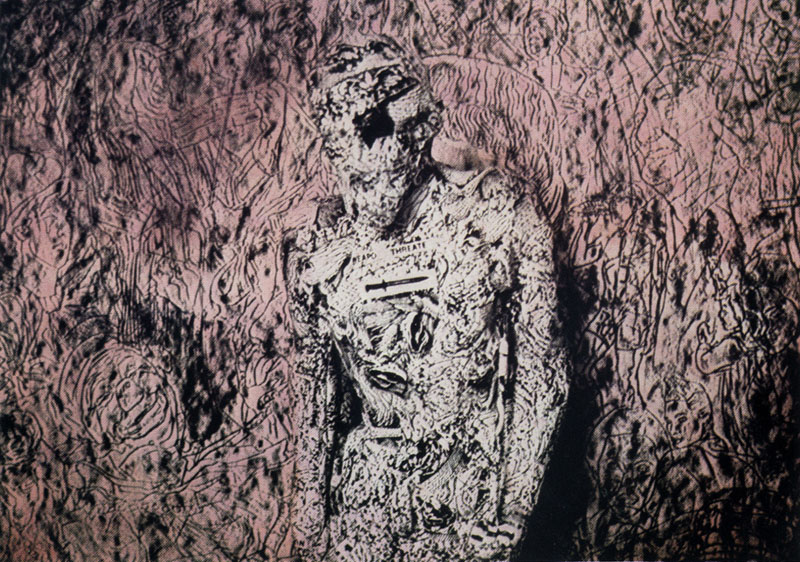
From the reading, I found the work by Joseph Nechvatal particularly interesting. His paintings (and animations) are degraded images of sexual body parts. They are degraded through the use of a computer virus and created by an assisting computer robot. The bio on his website (http://www.nechvatal.net/) was brief, but revealed that Nechvatal was educated in the philosophy of art and new technology. I think this part of his background is what's so interesting about his work, since I've never given much thought to technology, art, and philosophy altogether. Nechvatal combines these concepts to create artwork that it not only made using technology, but visually represents the organic and mechanical/virtual while also communicating to the viewer.
This is one of his early works created in 1986, titled Informed Man. Also found at http://www.nechvatal.net/ under the link "Selected computer-robotic canvases 1986-91.
I am very drawn to this piece, although it makes me feel uneasy. The obvious human figure in the center appears to be 3 dimensional and I think is made of news papers, which links with the title. The image of a dagger over the chest feels violent, and reminds me of the fear mongering that is always present in the news media. It also looks like the figure is wearing an eye patch which reminds me of my frustration with biased media reports that leave me feeling uninformed (or blind). Beyond the obvious human figure are many outlined faces. One appears to be a clown, another a judge. Their forms overlap in a frenzied way, with added tension from the ting of red color surrounding the center figure. There is a lot of movement, tension, and metaphor in this piece. Very Strong.
I think his work is important for the social commentary it offers. It is also important because it addresses the modern world, modern technology, and the virtual presence by using it to create these works.
I have given a lot of thought to the final project. I came up with a dozen ideas on incorporating food into art, such as creating a landscape in a diorama that resembled a landscape painting or layering parts of a cake to imitate a painting. I also considered sculpture made from different types of food, and even considered making a Dahli clock styled pizza (partly because I fear everyone will bring in desert type work). During the last class before finals, the topic of death came up and I started thinking a lot about it. Time and death have some pretty obvious links, so I chose to make a giant cookie to represent these two themes. It was too large to shape traditionally, but I managed to keep it together on my second try. I will update this blog with more details after it has been presented (I don't want to spoil the surprise.)
Update
The big reveal: A Giant Fortune Cookie. Inside is a running stopwatch and the fortune "When men speak of the future, the God's laugh."
I named this piece Death Clock. Generally, a death clock "predicts" when the user will die. This of course is nonsense as no one knows when their "time is up". It is still amusing for people to imagine that their future can be told. I think it is fascinating that people can be entertained by the concept of death, even their own. I chose to make a fortune cookie as the first layer to my edible metaphor, since it is a playful way for people to imagine the future. It was a double batch of batter (made mostly of egg whites, sugar, and flour) spread on a pizza pan. After it was baked, I placed the running stopwatch and the fortune inside. The clock started when the cookie was "born". It resets every 60 minutes, so there is no way to know how long the clock has been running. Ultimately, the message of this piece is that death is simultaneously serious and funny, and that no one knows when it will come.
People tend to overlook the unpredictability of life and constantly plan for tomorrow. When men speak of the future, the God's laugh.
New exhibits were installed in the Boyden Gallery. The largest exhibit looked like an arranged collage of white paper with curving black stripes. The rhythm created by this arrangement was confusing. There was also a collection of concrete slabs on display with strange foot prints within. One slab represented an adult, and another represented a baby of some imaginary creature. The texture distracted from the impressions of feet a little, and I noticed that the edges were already crumbling. The exhibits that I looked at the most was the collection called Aggregates, and Tactile Aggregates, by Garret Zopfi. Tactile Aggregates was intended to be handled by viewers. The collection that was brightly colored easily drew me in. Each piece was molded from plaster and sported a coat of neon spray paint. There were several molds used, but like-shapes were displayed together so that the arrangement very much resembled work by Andy Warhol, who was a source of inspiration for the artist. The shapes of the pieces seemed organic, and my first impression was that they looked like some non-human organs. It may be representative of, or inspired by, other organic forms such as root vegetables. The collection conveyed energy in the forms and the colors, and rhythm in repeated patterns. I thought it was the most interesting exhibit in the gallery.
The reading from The Object Stares Back was really interesting, mostly because I had never thought about how I see things. I started looking around, and to be honest I had a hard time noticing the things I don't see - which is a strange statement but Elkins did talk about our vision being filled with what we don't see. Some things limit our vision, some things divert out attention, and so on. I did have some success with a little experiment though. He talked about the distortions of out peripheral vision, so I created the scenarios he described to see if I would see things the way he claimed. I went into a hallway with a doorway at my side, and when I looked straight ahead the doorway did seem to be higher. I think that may have been caused by my inability to see the top of the door frame, which made it seem like the top was way over my head. I also tested the motion sensitivity of my peripheral vision with my hand at my side, which did play out the way he described. I also have been thinking about other things that change my vision. After he discussed the view though his window and a telescope, I recalled an illusion I often see with my glasses. I see points of light cast out from street lamps and cars at night, as if they were twinkling stars. I also see it during the day sometimes. I never gave it thought beyond wiping my lens clean (which helps, but doesn't remove the illusion). Now it seems to be one more filter in a list of things that impact my ability to see. It joins other physical filters like the amount of light available and the limitations of my eyes, as well as social filters which change the attention I give to certain images. It was a very though provoking reading, but I would have liked to see the pictures better.
This theme of "seeing" can be linked to some of the recent activities in class. We watched a short documentary in class on an artist that removes elements from videos to create his art, essentially making the things that we can't see become the focus of the word. One such video was an athlete in his moment of triumph, except that he had been removed from the moment and a ghostly void was left in his place. The things we can't see in his work make it very interesting, and a little uncomfortable (because we want to see what we know or think should be there).
We also created videos using shared recordings. Even though clips were reused, the end product of each persons video was really different, which demonstrates that we all see different meanings in the same image. The focus of this project may have been more about time, but our individual visions are clearly demonstrated in this project.
Most recently, we all studied and responded to a selected piece of art or an artist. I chose to study the work of Edvard Munch, whose most famous work is an expressionist painting call The Scream. It uses strong color and line to visually represent dark and ominous emotions, with the central figure seeming to warp under the pressure of so much emotional agony. It was a moment that Munch actually experienced, and managed to create visually even though feelings can't be seen.
Prof. Caldwell gave an insightful lecture on his work over the years. He
discussed his use of various tools in the production of his work, as well as
his artistic process and sources of inspiration.
The tools included cameras, of course, but not exclusively. He does not shy
away from exploring new ways to use available technology. For example, he used a
scanner to produce the series Spent,
which turned out remarkably well. Also of note, the tools used were not exclusively
for capturing images. Old hunting videos of his grandfather were used as a
source for his work, not by capturing new images but by using images that had
already been made and cycling the footage on different channels. From this
source also came How to Survive Your Own
Death, produced by corrupted data when transferring footage. These are
examples of how compelling works of art may be produced when the medium is
approached in new, creative ways.
An important element that was discussed about his work was the sense of
place. In some ways, the use of space defined the "place". In another
way, I thought the "place" was more of a place in time or in memory.
The nostalgia of the past was an element that recurred in his work, which
started with hunting videos of his grandfather. So much of the work presented
during the lecture seemed to echo the element “past”, of hunting, or both.
I found the timeline of his work interesting. From the work he discussed, it began with super 8 film of his grandfather hunting. Then he made portraits, with the land and the composition calling back to the films. Next, he focused on the land itself. This led to hunting structures, and shot gun shells as subject matter. When the series are viewed individually, it may not be noticed; but, as a whole it suggests something about the artist. To me, it suggests a fixation on the past and on the ritual of the hunt, which is very much linked to his Grandfather.
There's a lot of activity to discuss. Over the last few classes there have been a variety of art projects, readings, and videos. The theme that ties it all together is the exploration of perception.
The movie Memento was interesting, but also surprising. The main character's perception of reality was very confusing due to his memory problems, but was also possibly fictional. I had previously considered the twisted relationship between reality and memory in my last post, and this movie expressed theatrically the very issue that I was questioning.
The in-class assignments explored perception in a few ways that were very engaging. I have used a viewfinder in the past, so I was familiar with limited perspectives of objects as well as viewing negative spaces. The chair/stool project was a new approach to representing an isolated part of a scene, and I was really pleased with the results. In another project using non-representational art with limited shapes and colors, we attempted to effectively express an emotion in our art work. Perception was key for the artist and the viewer to communicate, and interpretations were not always accurate. The most interesting project was the most recent. I have seen paintings that reminds me of jazz music, but nothing visual has ever expressed other types of music to me. Listening to different music in class and trying to represent what I heard in a visual way was surprisingly difficult. I have doubts that it successfully expressed what I heard, but it was a great exploration of synesthesia. I found a great short film about this disorder that I want to share.
From the reading by John Berger I was surprised by myself in that I had never considered how I think of old art. The chart that listed different places posed the question as to what location I thought was most like a museum...I did think of a church. That was the point in the reading were I understood the "mysticism" surrounding art that is brought up so many times. There is a sense of reverence in a church. No where else in the world do I feel the same level of awareness (being self conscious of behavior for example) and mystery (the mysteries of God, heaven, & many other aspects of religious belief). I also consider some churches to include art in sculpture, in windows, and in paintings; all of which I view with the same respect that I would give to art in a museum or gallery.
The podcast wasn't my favorite since I prefer visual over auditory, but it was still interesting. I had never heard about the role the railroads played in standardizing time, nor had I heard of scent calendars and spice timers... Apparently Yankee Candle sold a scented wall calendar in 2010, and I found a so-called scented calendar here (http://www.ahalife.com/product/119/scent-calendar/) but it's a wall calendar with scented candles. I found nothing regarding spice timers. I would love to see such things marketed simply for the novelty of it! Also from this podcast came a rousing group discussion on relativity and time, which is still a difficult concept for me. Somehow, time flows at different rates depending on the movement of the person/object/etc in relation to the surrounding environment?? I have perceived time moving faster or slower, but it isn't something I grasp as a physical sensation. I don't feel as though time actually has moved faster or slower, only that I lost my sense of it.
We also looked at some abstracted paintings where movement over time was expressed. On the left is a painting by Duchamp shown in the class which I thought best represented this idea. (The woman walking the dog was also a great selection, but I didn't like it as much.) The subject of time in abstract art reminded me of the work on the left by a digital photographer (Benedetti) which I came across due to my interest in the field of digital photography.